Board games · Maths
Dice probability for board gamers
Dice probability made practical: the odds of each total on two dice, chances of rolling a six, average rolls and how designers and casino games use the numbers.
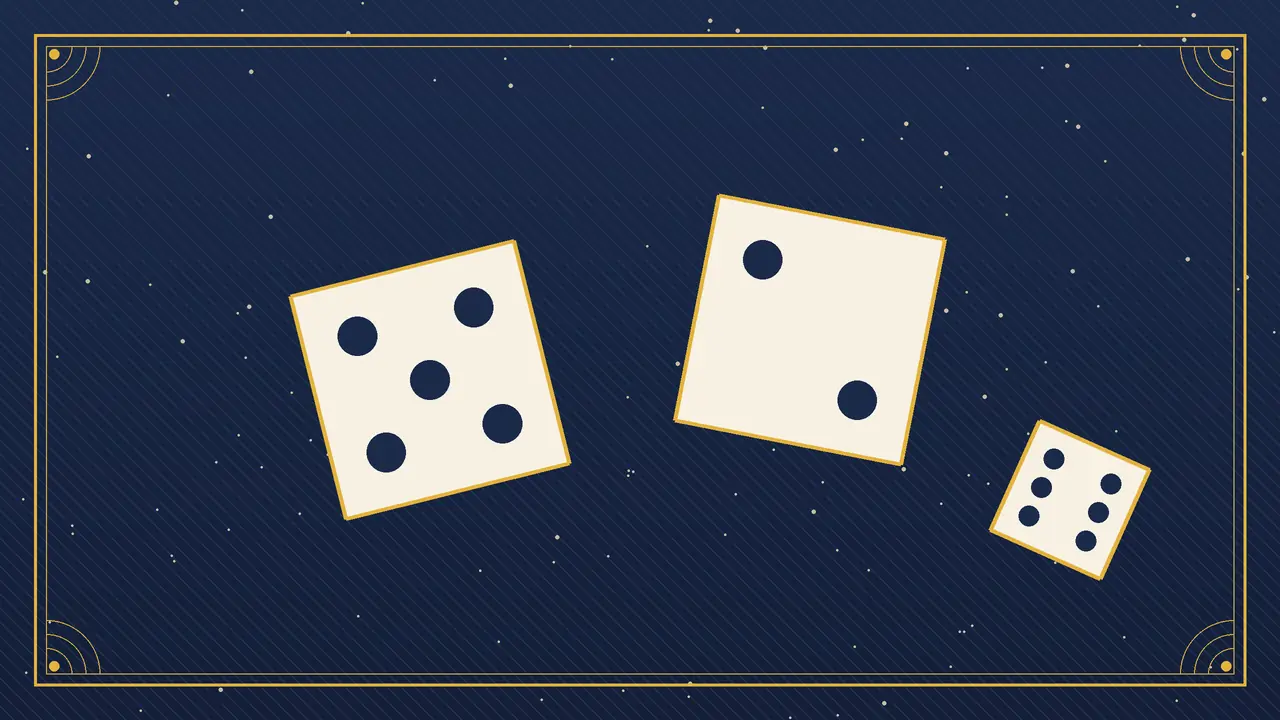
A single six-sided die is perfectly fair: each face has a 1 in 6 chance, about 16.7%. Add a second die and fairness disappears — some totals become far more common than others. Understanding that one shift will make you better at Catan, Monopoly, Scrooge and craps alike.
One die: the basics
- Each face: 1/6 ≈ 16.7%.
- Average roll: 3.5.
- Chance of at least one six in four rolls: 1 − (5/6)⁴ ≈ 51.8%. Just better than even — which is why “I’ll get a six eventually” is true, but slower than people think.
Two dice: the bell curve
With two dice there are 36 equally likely combinations. Totals in the middle can be made in more ways.
| Total | Ways to roll | Probability |
|---|---|---|
| 2 | 1 | 2.8% |
| 3 | 2 | 5.6% |
| 4 | 3 | 8.3% |
| 5 | 4 | 11.1% |
| 6 | 5 | 13.9% |
| 7 | 6 | 16.7% |
| 8 | 5 | 13.9% |
| 9 | 4 | 11.1% |
| 10 | 3 | 8.3% |
| 11 | 2 | 5.6% |
| 12 | 1 | 2.8% |
Seven is the most likely total — six times more likely than a 2 or a 12. The average total is 7.
How designers use it
Board designers place their most important squares where the numbers say players will land. In Monopoly, the orange set is famous because it sits six to nine squares after Jail, the most common distances from the most visited square. In Catan, the numbers 6 and 8 are printed in red because they produce resources most often.
Race games like Scrooge use the same maths in reverse: penalty streets placed at common distances from busy squares hit players more often. If a nasty street sits seven squares ahead, it is the single most likely landing spot on a two-dice roll.
Expected value: the number that matters
Expected value (EV) is the average result of a decision if you repeated it many times. Multiply each outcome by its probability and add them up. A bet that pays £35 on a 1-in-37 chance and costs £1 has an EV of (35 × 1/37) − (1 × 36/37) ≈ −£0.027 per pound — that is European roulette’s house edge of 2.7%.
EV turns gut feelings into numbers. You will not always win a positive-EV play, but over many decisions EV is what you collect.
At the casino table
Craps is built entirely on two-dice probability. On the come-out roll, a 7 or 11 wins the pass line (8 of 36 combinations) and a 2, 3 or 12 loses (4 of 36). The remaining totals set a “point”, and the bet resolves on whether the point or a 7 comes first. Our craps guide walks through every bet and its house edge.
Takeaway
Dice are fair individually and predictable in aggregate. Use the bell curve to judge risk on the board, use expected value to judge decisions, and remember that no amount of maths changes a fixed house edge — it only tells you how big it is.